
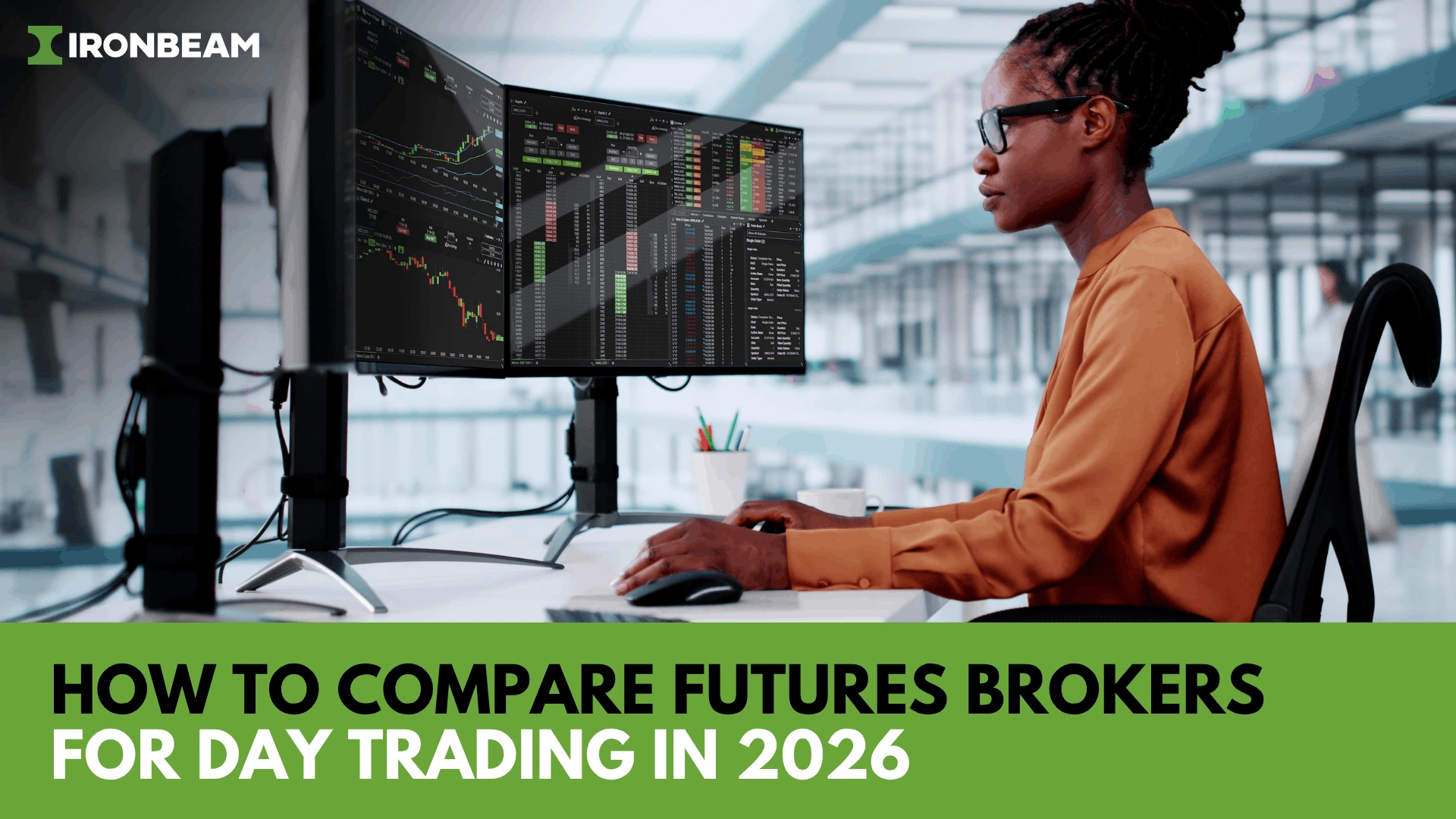
How to Compare Futures Brokers for Day Trading in 2026
If you are actively day trading futures in 2026, the broker and platform you choose will directly influence your fills, your risk, and how confidently you can trade fast markets. The best futures trading platforms for intraday traders combine competitive margins, reliable technology, and responsive support instead of treating futures as an afterthought.
This guide gives you a decision‑stage checklist for comparing futures trading brokers and futures trading accounts, with examples of how a futures‑focused firm like Ironbeam approaches each area.
Start with how you day trade
Before you compare any futures trading platforms, get clear about how you actually trade. The right partner for a high‑frequency trader scalping micro contracts is different from the right fit for someone taking a couple of intraday positions each week.
Think about three simple profiles:
Scalpers and high-frequency futures trading
You live in the depth of market, place many orders each session, and care most about execution speed, platform stability, and advanced order entry tools. You need low intraday margins, reliable routing, and a platform that stays responsive around the open, economic releases, and contract rolls.
Intraday swing traders
You may take a handful of trades per day and hold for minutes to hours. You still need tight spreads and clean execution, but your focus is on chart quality, ergonomics, and predictable costs as position size grows.
Part‑time or overnight futures traders
You often trade outside regular stock market hours, so you need a futures trading account that offers robust overnight performance and support that understands futures when you have questions.
Write down a few details before you compare brokers: your average round turns per day, your main contracts (for example, MES, MNQ, NQ, ES, CL, GC), and how long you typically hold trades. That basic profile will help you filter futures trading brokers much more quickly.
Margins and risk policies: look under the hood
Many traders start with margins when comparing futures trading accounts, but the headline number does not tell the whole story. Futures margin is a good‑faith deposit set by the exchange and adjusted by the broker. It represents a fraction of the contract’s notional value, not a fee.
You will usually see three levels for each contract:
- Initial margin to open a position.
- Maintenance margin to hold that position overnight.
- Reduced day trading margin that applies only to intraday positions.
Ironbeam’s own margin guidance makes this very clear for active traders. For example, the Micro E‑mini S&P 500 (MES) can be traded on 50 dollars of intraday margin, while the overnight exchange margin is more than 2,300 dollars for the same contract. That gap shows how powerful day trading futures can be and why you must treat leverage with respect.
When you compare futures trading brokers, focus less on who posts the lowest number and more on how they manage risk around that number:
- How are day trading margins and overnight margins defined for the contracts you plan to trade?
- At what time does the platform shift from day margins to overnight margins, and how are open positions treated at that cutoff?
- How does the firm handle forced liquidation and margin calls in fast markets?
A futures‑focused broker will publish these details clearly, often with contract‑specific examples and FAQs, so you can build position sizing and risk rules around them before you scale up.
The full cost of day trading futures
Commission per contract matters, but it is only one piece of the total cost of using a futures trading platform. Every round turn includes:
- Per‑side commission
- Exchange and clearing fees
- Any platform or license fee
- Market data charges
Top futures trading platforms for active traders aim to keep all‑in costs competitive by balancing commission levels with free or low‑cost access to powerful trading tools and data. Less optimized setups may advertise low commissions but make up for it with higher platform fees or data costs that add up quickly for high‑frequency futures trading strategies.
Ironbeam positions itself as a futures trading broker with straightforward pricing. Its own cloud‑based futures trading platform is free to use, and many users can access real‑time data without a separate monthly platform fee. There is also no account minimum to open a futures trading account at Ironbeam, which lets newer traders start with micro contracts and size their capital appropriately.
When you evaluate any broker, run your actual numbers instead of relying on slogans. Take your expected contracts per trade, average round turns per day, and trading days per month, then apply each firm’s commissions, exchange fees, and any platform or data charges. Even a small difference in effective cost per round turn becomes meaningful once you move beyond a few trades per week.
Platform experience and integrations
This is where futures trading platforms truly differentiate themselves for day trading. In 2026, serious brokers tend to offer a modern, free cloud‑based trading platform and connectivity to professional third‑party platforms, so you do not have to change brokers every time your workflow evolves.
Key things to look for:
Fast, reliable order entry
You want one‑click order placement, DOM or ladder trading, OCO and bracket orders, and simple flatten and reverse controls. These tools become critical the first time you need to adjust or exit a futures trade during a sharp move.
Professional charting tools
Day trading futures often relies on tick, range, and volume charts, plus multiple time frames on one screen. A good platform will let you save custom workspaces, layouts, and indicator combinations for specific markets.
Free cloud-based trading platforms
Ironbeam’s own futures trading platform is a free, cloud‑based platform built for active futures traders, available on desktop, web, and mobile. You can trade from almost any device without managing software installs or updates, which is ideal if you move between home, office, and mobile.
Integrations with TradingView, Sierra Chart, and more
Many intraday traders want to pair their futures trading accounts with charting and automation environments like TradingView or Sierra Chart. Ironbeam supports Sierra Chart with direct order routing and provides access to a broad lineup of supported futures trading platforms that can plug into its clearing infrastructure.
When you compare futures trading platforms, ask whether your broker can support the platform you want to use today and where you want to be a year from now. You might start on a free cloud‑based trading platform, then graduate to Sierra Chart or Ironbeam API for an automated system. Choosing a broker that supports that path up front can save you from unnecessary account transfers later.
Market data, infrastructure, and uptime
Good decisions in day trading futures depend on accurate, real‑time market data and an infrastructure that can keep up. At minimum, you want streaming level 1 quotes; many intraday and high‑frequency strategies also benefit from depth‑of‑market and dedicated exchange feeds.
When you evaluate any futures trading platform, pay close attention to how your broker handles live market data and order routing. A strong setup will pair direct connectivity to the major exchanges with a reliable data feed so your quotes and fills are not passing through unnecessary third parties. For example, the Ironbeam platform uses a dedicated order routing system that sends orders directly to the exchange and delivers unfiltered market data, which helps reduce latency and keep your view of the market as close to the source as possible
Reliability matters as much as raw speed. Established futures trading brokers focus heavily on:
- Platform uptime during both regular and extended trading hours
- Order routing performance during major news events and contract rolls
- Real‑time risk systems that monitor positions and margin as markets move
Ironbeam describes itself as an industry‑leading futures broker and cloud‑based futures trading platform, with technology designed specifically for active futures traders rather than general multi‑asset use. That kind of infrastructure focus is what you want to see when you read any broker’s platform and technology pages.
Support and education built around futures
When you have a question about margins, expirations, or a platform issue during a live session, you want support from people who understand futures trading accounts and the platforms you use. That is why support quality and educational depth should factor into any comparison of futures trading brokers.
Futures‑focused firms invest in:
- Direct phone support during market hours with staff who specialize in futures markets and platforms
- Email, knowledge base, and community resources that cover platform setup, market data, and margin policies in detail
- Education aimed at futures traders, including content on how futures margins work, how much money you realistically need to start, and how to set up platforms like Ironbeam correctly
Ironbeam’s knowledge base and education library cover topics such as how futures margins work, how to open a futures trading account, and how much capital is recommended for trading micro and mini contracts.
When you are comparing futures trading brokers, do a simple test. Reach out during trading hours with a detailed question about margins or data on a specific contract you plan to trade. The clarity and speed of the answer will tell you a lot about how seriously they take active futures traders.
What a futures‑first broker looks like in 2026
Once you know your trading style and have this checklist, it becomes much easier to evaluate futures trading platforms and futures trading accounts at the decision stage. The brokers that truly focus on day trading futures tend to share a few core traits:
- A free, cloud‑based futures trading platform with full functionality across web, desktop, and mobile, plus support for professional third‑party futures trading platforms.
- Competitive, clearly published day trading margins and overnight margins on actively traded CME contracts, backed by transparent risk and liquidation policies.
- Simple, transparent pricing on commissions, platform access, and market data for active day traders, with no arbitrary account minimums that keep smaller but serious traders out.
- Real‑time data options and a technology stack designed specifically for intraday and high‑frequency futures trading.
- Futures‑savvy support and education that help traders move from their first micro contract to more advanced trading setups with confidence.
Ironbeam fits that futures‑first profile closely. We are an industry‑leading futures broker and cloud‑based futures trading platform, with no account minimums, competitive intraday margins, and free access to a professional‑grade platform.
From here, you can apply this framework to any shortlist of futures trading brokers and quickly see which ones are truly built around active day trading and which ones are better suited for occasional or long‑term futures use.
About the Author
Mike Murphy is Director of Business Development at Ironbeam, where he’s worked since 2013. He holds a Series 3 license and has spent 15+ years in financial markets, working at the intersection of futures trading and the technology that powers it. He writes about market structure, trading platforms, and what it actually takes to access futures markets efficiently.
Disclaimer: There is a substantial risk of loss in trading commodity futures and options products. Losses in excess of your initial investment may occur. Past performance is not necessarily indicative of future results. Please contact your account representative with concerns or questions. The information contained here is accurate to the best of our knowledge at the time of this writing. However, various circumstances may change over time which could affect the accuracy of the information presented. Ironbeam Inc makes no guarantees and recommends verifying details before making any decisions based on this content.