

E-mini vs. Micro vs. E-nano Futures: Which Contract Size Fits Your Strategy
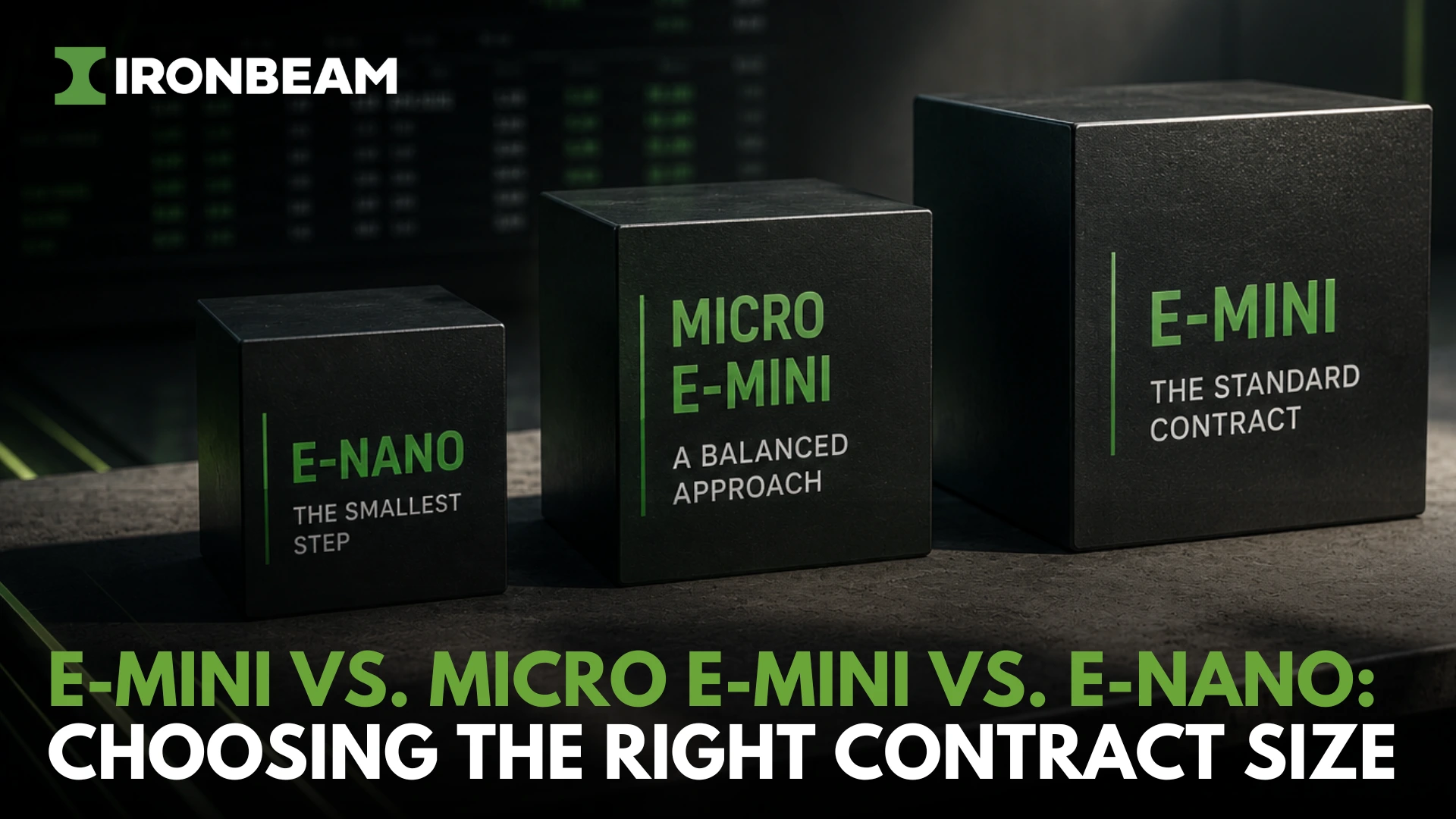
E-mini, Micro E-mini, and E-nano futures all track the same underlying index, but they differ by a factor of ten at each step down. An E-mini S&P 500 contract carries a $50 multiplier, a Micro E-mini carries $5, and the new E-nano carries $0.50. Picking the right size comes down to account size, position-sizing precision, and how much notional exposure you actually want per trade.
If you already trade Micro E-minis, you’ve probably felt the gap between “one contract” and “ten contracts” when index levels climb. E-nano futures close that gap. Here’s how the three contract sizes stack up on futures margin requirements, notional exposure, and where each one actually fits in a trading plan.
Contract Size and Multiplier Comparison
The multiplier is the dollar amount each contract moves for every one-point change in the index. It’s the single number that determines how much a given contract size actually costs you to hold.
Index | E-mini multiplier | Micro E-mini multiplier | E-nano multiplier |
S&P 500 | $50 | $5 | $0.50 |
Nasdaq-100 | $20 | $2 | $0.20 |
Russell 2000 | $50 | $5 | $0.50 |
Dow Jones Industrial Average | $5 | $0.50 | $0.05 |
Ten E-nano contracts equal one Micro E-mini contract in notional terms. One hundred E-nano contracts equal one full E-mini contract. That fungibility is built into CME’s offset rules, so a trader can scale a position up through E-nano contracts and later consolidate into Micro or E-mini size without closing and re-opening the trade from scratch.
Notional Exposure at Current Index Levels
Multiplier alone is abstract until you see it against a real index level. At a hypothetical S&P 500 level of 7,000 points, the difference in capital commitment across contract sizes is stark:
- E-mini S&P 500: $350,000 notional exposure
- Micro E-mini S&P 500: $35,000 notional exposure
- E-nano S&P 500: $3,500 notional exposure
That tenfold step-down repeats across every index CME offers in E-nano form. For a trader working with a $10,000 to $25,000 account, a single Micro contract on the S&P 500 already represents a meaningful chunk of buying power. An E-nano contract lets that same account build a position in smaller increments, which matters more for risk management than most traders give it credit for.
Margin Requirements Across Contract Sizes
Futures margin is a performance bond, not a down payment, and CME sets exchange-level minimums that brokers then apply their own day-trading and overnight schedules on top of. Published day-trading margins vary by broker, but the proportional relationship holds across contract sizes. Ironbeam, for example, has historically posted day-trading margins around $50 per Micro contract and $500 per E-mini contract on products like the S&P 500. Applying the same 10:1 relationship CME uses for contract sizing, an E-nano day-trading margin would land somewhere in the $10 to $25 range once brokers finalize their schedules, though CME has not yet published fixed E-nano margin figures and final numbers will depend on volatility at the time of launch.
Overnight margin, which CME sets directly and which tends to run five to ten times higher than day-trading margin, will follow the same proportional pattern once confirmed. We’ll update this section with confirmed numbers as soon as CME publishes them ahead of the August 24 launch.
Metric | E-mini S&P 500 | Micro E-mini S&P 500 | E-nano S&P 500 (estimated) |
Multiplier | $50 | $5 | $0.50 |
Approx. notional at 7,000 | $350,000 | $35,000 | $3,500 |
Typical day-trading margin | ~$500 | ~$50 | ~$10-25* |
*Estimated by proportion. Not an official CME or Ironbeam figure until confirmed at launch.
Which Contract Size Fits Your Strategy
The right size isn’t about which contract is “better,” it’s about matching contract size to account size and strategy intent.
- Full E-mini fits accounts with substantial capital and strategies designed around institutional-scale notional exposure, or traders hedging a larger equity portfolio one-to-one.
- Micro E-mini fits most retail day traders and swing traders. It’s been the default entry point for futures trading for beginners since 2019, and CME data shows Micro contracts now account for 54% of total Equity Index average daily volume.
- E-nano fits traders who want to scale into or out of positions gradually, test new strategies with minimal capital at risk, or manage a small account where even one Micro contract represents an outsized swing.
This also reframes the futures trading vs. stock trading comparison. A trader who’s been using fractional shares to size an equity position precisely now has a futures contract that offers similar precision, with the added benefits of extended trading hours, built-in leverage efficiency, and CME’s centralized clearing.
Scaling Between Sizes
Because E-nano futures are fungible with Micro and E-mini contracts through CME’s offset mechanism, you’re not locked into one size for the life of a trade. A trader could open a position in E-nano contracts to test a setup, add size as conviction builds, and request an offset into Micro E-mini contracts once the position reaches a size where the larger increment makes more sense operationally. That flexibility didn’t exist before this launch. Previously, moving from Micro to E-mini size required closing one position and opening another.
If you’re deciding which contract size and which broker fit your account, our guide on choosing a futures broker walks through margin schedules, platform access, and commission structure in more detail. And if you haven’t opened a futures account yet, you can do that directly through Ironbeam’s account opening page before E-nano contracts list on August 24.
Frequently Asked Questions
What is the difference between E-mini, Micro E-mini, and E-nano futures?
They track the same underlying index but differ in contract multiplier by a factor of ten at each step. E-mini futures carry the largest multiplier, Micro E-mini futures are one-tenth that size, and E-nano futures are one-tenth the size of Micro E-mini contracts, or one-hundredth the size of the full E-mini.
How much margin do I need for an E-nano futures contract?
CME has not published official E-nano margin figures yet. Based on the proportional relationship used for Micro E-mini contracts, day-trading margin is expected to land roughly one-tenth of the corresponding Micro E-mini margin, though final numbers depend on market volatility at launch.
Can I convert an E-nano position into a Micro E-mini position?
Yes. E-nano futures can be offset against Micro E-mini positions at a 10:1 ratio and against E-mini positions at a 100:1 ratio through your clearing broker.
Which contract size is best for a beginner futures trader?
Most beginners start with Micro E-mini contracts, which already offer significantly lower notional exposure than full E-mini contracts. E-nano futures push that accessibility even further for traders who want to size positions more precisely or manage a smaller account.
About the Author
Mike Murphy is Director of Business Development at Ironbeam, where he’s worked since 2013. He holds a Series 3 license and has spent 15+ years in financial markets, working at the intersection of futures trading and the technology that powers it. He writes about market structure, trading platforms, and what it actually takes to access futures markets efficiently.
Disclaimer: There is a substantial risk of loss in trading commodity futures and options products. Losses in excess of your initial investment may occur. Past performance is not necessarily indicative of future results. Please contact your account representative with concerns or questions. The information contained here is accurate to the best of our knowledge at the time of this writing. However, various circumstances may change over time which could affect the accuracy of the information presented. Ironbeam Inc makes no guarantees and recommends verifying details before making any decisions based on this content.