
CME Compute Futures: A New Market for AI Infrastructure Risk
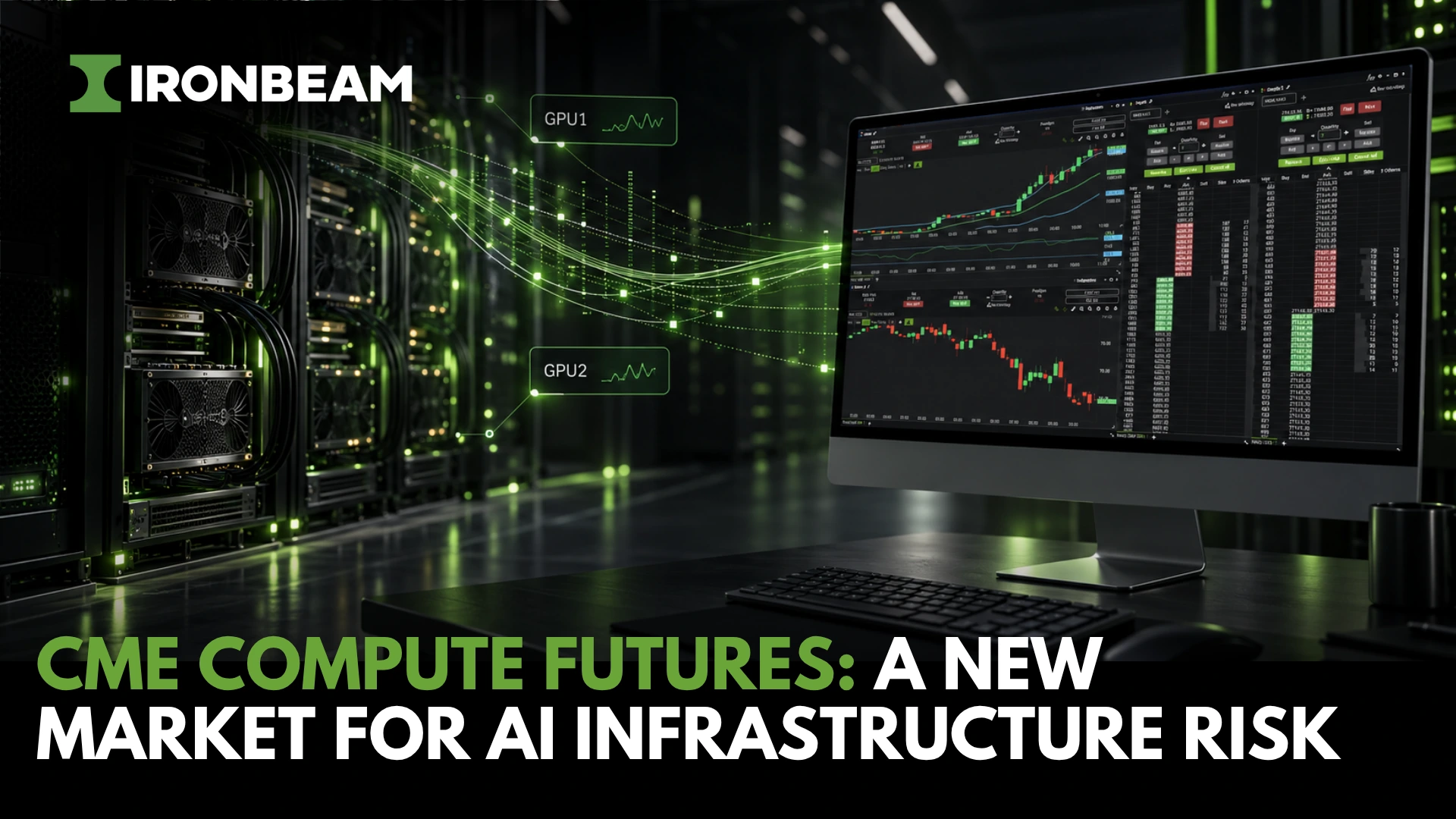
CME Group compute futures will create an exchange-traded market for the rental cost of AI processing power. The proposed H100 and B200 contracts could help institutions hedge GPU expenses or capacity revenue while giving individual traders direct access to AI infrastructure pricing. Once approved and listed, Ironbeam plans to offer both contracts.
The AI trade has mostly reached futures traders indirectly through equity indexes, semiconductor stocks, energy markets, and individual technology companies. Compute futures are different. Their underlying reference is the hourly rental rate for specific GPUs, placing the economics of AI infrastructure itself at the center of the contract.
That distinction is what makes this launch important. Compute is both a major expense for AI builders and a revenue stream for cloud providers. CME Group and Silicon Data are attempting to standardize that two-sided risk in a centrally cleared futures market.
Launch status as of October 6, 2026: The contracts remain under regulatory review. CME originally targeted October 5, but the CFTC extended its review through November 9. CME’s revised notice says the effective date will be announced, so November 9 should not be treated as the launch date.
What Are CME Compute Futures?
Compute futures are proposed NYMEX contracts tied to Silicon Data indexes that measure hourly on-demand GPU rental costs in the neocloud market. GPU1 will reference NVIDIA H100 rental rates, while GPU2 will reference NVIDIA Blackwell B200 rental rates. Both will settle financially, so no GPU hardware or cloud capacity changes hands at expiration.
Each contract represents 730 GPU-hours, roughly one GPU running continuously for a month. Prices are quoted in dollars per GPU-hour, and the minimum price movement of $0.01 is worth $7.30 per contract. CME plans to list 36 consecutive monthly expirations, giving the market the framework for a forward curve reaching three years.
Why Institutions Need This Market
Compute has developed into a material operating expense without a mature, standardized market for transferring its price risk. AI developers and enterprises can negotiate cloud agreements or reserve capacity, but those contracts are provider-specific and often bundle price with service terms. Compute futures separate the rental-price exposure from the physical service relationship.
That separation gives several types of institutions a practical hedging tool:
· AI developers and enterprises can buy futures to offset the risk that GPU rental costs rise before a training cycle, product rollout, or sustained inference workload.
· Neoclouds and infrastructure operators can sell futures to protect expected rental revenue if added capacity or weaker demand pushes market rates lower.
· Data-center investors and lenders can use a transparent forward curve when evaluating projected cash flow, collateral values, and financing assumptions.
· Financial institutions can trade the curve, provide liquidity, structure compute-linked products, or manage exposure created by financing AI infrastructure.
CME specifically identifies financial institutions, AI builders, cloud-service providers, and traders as intended users. Its stated objective is to provide more reliable tools for valuation, hedging, and long-term planning in the compute market.
Silicon Data reported annualized realized volatility of 26.2% for its H100 neocloud rental index and 30.2% for its B200 index over the available periods through August 14, 2026. Its H100 series experienced a maximum drawdown of 45.3% and a maximum run-up of 50.5% during the measured period.
For a compute buyer, that volatility can disrupt budgets and product economics. For a capacity provider, it can reduce revenue available to service debt or justify new hardware investment. Futures cannot eliminate commercial risk, but they can isolate part of the price exposure and move it into a market designed for daily valuation, margining, and centralized clearing.
A practical institutional hedge
Assume an AI company expects to use 100 H100 GPUs continuously during a future month. Because one GPU1 contract represents one GPU-month, 100 contracts would create a roughly matched hedge against the index component of that rental cost. The company would buy GPU1 futures if it feared higher rates.
A cloud provider expecting to lease 100 H100 GPUs during the same month could take the other side of that risk by selling 100 contracts. If rental benchmarks decline, gains on the short futures position could offset some of the reduction in rental revenue.
The hedge will not be perfect. A company’s actual invoice may differ from the index because of geography, cluster configuration, networking, service quality, term commitments, and provider premiums. That difference is basis risk, and it should be measured before the hedge is sized.
What Retail Traders Gain
Individual traders will gain something different: direct market access to the price of AI compute. A trader will not need to select a chip stock, forecast one company’s earnings, or buy physical hardware to express a view on H100 or B200 rental economics.
That creates several possible approaches. A trader could take a directional view on rising or falling GPU rental rates, trade differences between contract months, or study the relationship between H100 and B200 pricing as hardware demand shifts between generations.
The qualification matters. A new contract can begin with thin order books, wide bid-ask spreads, and uneven volume across expirations. The existence of a compelling economic use case does not guarantee immediate liquidity. Early retail participation should be based on visible market depth and executable pricing, not the assumption that an important theme automatically creates an efficient market.
The contract size is approachable, but “approachable” does not mean low risk. Every $1.00 move in the quoted GPU-hour price changes one contract’s value by $730. Traders also need to account for exchange and broker margin requirements, which may change as the market develops.
Why Trade Compute Futures at Ironbeam?
Compute futures will likely attract very different users, from traders taking a directional view on AI infrastructure costs to firms hedging GPU rental exposure. We give you the flexibility to trade the way your operation already works: through our cloud-based platform, supported third-party platforms, or an API connection built for automated execution and internal risk workflows.
That matters with a new market. You can monitor liquidity, manage positions, and adjust orders from the same futures trading environment you use for other markets, rather than adding another provider or workflow solely to trade compute futures.
One platform for discretionary trading
The Ironbeam platform is a free, cloud-based futures trading platform available through web, desktop, and mobile devices. It includes depth of market, chart trading, server-side workspaces, advanced order strategies, and direct market data, giving traders the tools to monitor a new contract as liquidity develops.
Because layouts and trading tools are cloud-based, you can follow GPU1 or GPU2 from a desktop and manage the same account from a supported mobile device. Ironbeam also supports third-party platforms for traders who already have an established futures workflow.
Explore the Ironbeam futures trading platform and supported futures trading platforms.
Infrastructure for institutional and systematic users
Institutions and quantitative traders can access Ironbeam’s REST and WebSocket API for orders, positions, balances, fills, quotes, and market-depth streams. The API is hosted at the exchange data center and is designed for automated futures trading and custom risk-management systems.
That matters for compute hedgers because institutional positions may be driven by internal exposure data rather than discretionary chart signals. A business could connect forecast GPU usage, current capacity, or procurement schedules to an internal dashboard and use Ironbeam’s API as the execution layer, subject to its own controls and approvals.
Review the Ironbeam futures trading API for current technical details.
Support when the market is new
New contracts create operational questions that established markets settled years ago: which months are active, how does the settlement index work, what market-data entitlement is needed, and where is usable liquidity? Ironbeam provides a 24-hour trade desk and technical support while the futures markets are open.
This combination of direct CME Group clearing, multi-device trading, API access, and futures-specific support makes Ironbeam well positioned for both sides of the compute futures market. Commercial hedgers can build structured workflows, while individual traders can access the same listed contracts through a platform designed specifically for futures.
When Will Trading Begin?
There is no confirmed launch date. The CFTC extended its review of the proposed H100 and B200 futures through November 9, 2026, after determining that the submission raised novel or complex issues requiring additional analysis. CME later changed the effective date to “to be announced.”
CME still describes the contracts as planned for later in 2026, but that is a target rather than a guarantee. Traders should monitor the official CME compute futures page and Ironbeam updates for regulatory approval, the final trade date, initial margin requirements, market-data availability, and supported platform connections.
Risks Before You Trade
Compute futures will provide a new form of exposure, but they will retain the familiar risks of futures trading. Positions are marked to market, margin requirements can change, and losses can exceed the amount initially deposited.
Traders should also account for risks specific to this market:
· Liquidity risk: Early volume and order-book depth may be limited.
· Basis risk: A company’s actual rental price may not track the Silicon Data neocloud index precisely.
· Technology risk: New hardware and efficiency improvements can alter demand for older GPU generations quickly.
· Curve risk: Different delivery months or GPU generations may not move together as expected.
Commercial users should size hedges against documented exposure rather than total business value. Individual traders should use limit orders, confirm the tick value, and define risk before entering a market without an established trading history.
Compute Futures FAQ
Are compute futures based on NVIDIA stock?
No. GPU1 and GPU2 will reference Silicon Data indexes that measure hourly rental rates for NVIDIA H100 and B200 GPUs in the neocloud market. They will not track NVIDIA shares, company earnings, or physical chip purchase prices.
Who can use compute futures for hedging?
Potential institutional users include AI developers, enterprises, cloud-service providers, data-center operators, infrastructure investors, lenders, and financial institutions. Buyers can hedge rising rental costs, while providers can hedge falling capacity revenue.
Can individual traders trade compute futures?
The contracts are designed for trading on CME Globex, so eligible futures traders will be able to access them through supporting brokers after approval and listing. Ironbeam plans to make GPU1 and GPU2 available, subject to final exchange, margin, market-data, and platform requirements.
Do the contracts deliver GPUs?
No. Both contracts will settle financially against the applicable Silicon Data index methodology. Expiration results in a cash adjustment rather than delivery of hardware or cloud capacity.
When will compute futures launch?
No date is confirmed as of October 6, 2026. The CFTC’s extended review runs through November 9, and CME says the effective date will be announced.
Prepare for the Launch
You can prepare before the first trade date by opening and funding an Ironbeam account, learning the platform, and deciding how compute futures fit your trading or hedging process. Commercial firms considering an institutional hedge should also map their GPU exposure by model, month, and rental-price basis before choosing a position size.
About the Author
Brent Murphy is a Series 3-licensed broker and Business Development Specialist at Ironbeam. For the past six years, he has partnered with traders, introducing brokers, funds, CPOs, and CTAs, delivering technology, trading, and clearing solutions to help clients succeed in the futures markets.
Disclaimer: There is a substantial risk of loss in trading commodity futures and options products. Losses in excess of your initial investment may occur. Past performance is not necessarily indicative of future results. Please contact your account representative with concerns or questions. The information contained here is accurate to the best of our knowledge at the time of this writing. However, various circumstances may change over time which could affect the accuracy of the information presented. Ironbeam Inc makes no guarantees and recommends verifying details before making any decisions based on this content.